Home / Shade Chronicles / Advantages
Skate Park Shade Structures: A Commercial Buyer’s Guide
See where to place skate park shade structures, which vandal-resistant materials hold up, ADA access and wind-load specs, and buying mistakes to avoid.
On this page
- 01What Skate Park Shade Structures Are (and Aren’t)
- 02Why Shade Matters for Skate Park Operations
- 03Placement: Shading Rest and Spectator Zones Without Touching the Riding Surface
- 04Vandal-Resistant Hardware and Materials for Skate Parks
- 05Compliance and Safety: ADA Access, Wind Engineering, and Site Conditions
- 06Materials and Specs: Steel Frames, Fabric Options, and Powder Coating
- 07Custom Canopies’ In-House Process for Skate Park Projects
- 08Common Buying Mistakes with Skate Park Shade Projects
- 09Cost Drivers for Skate Park Shade Structures
- 10FAQ
- 11Get a Site-Specific Quote for Your Skate Park
Parks and recreation departments spend years planning a skate park’s layout, its transitions, its bowls, its rail lines, and then discover on the first 95-degree opening day that nobody accounted for shade. Skate park shade structures solve a problem that is easy to overlook in the design phase and expensive to fix after the concrete is poured: riders, parents, and spectators need somewhere to cool off that does not interfere with the riding surface itself. For facilities directors, parks and recreation managers, and municipal procurement teams, getting skate park shade structures right means understanding placement rules, vandal-resistant hardware, wind engineering, and the compliance details that keep a project out of the change-order pile.
This guide walks through what skate park shade structures are, why commercial-grade shade matters for skate park operations, how to place a structure without compromising rider sightlines or safety zones, and what materials and specs hold up under the vandalism, heavy foot traffic, and board-slide abuse that skate parks see every day. We will also cover Custom Canopies’ in-house manufacturing process, the buying mistakes municipalities make most often, and the cost drivers that shape a skate park shade budget.
What Skate Park Shade Structures Are (and Aren’t)
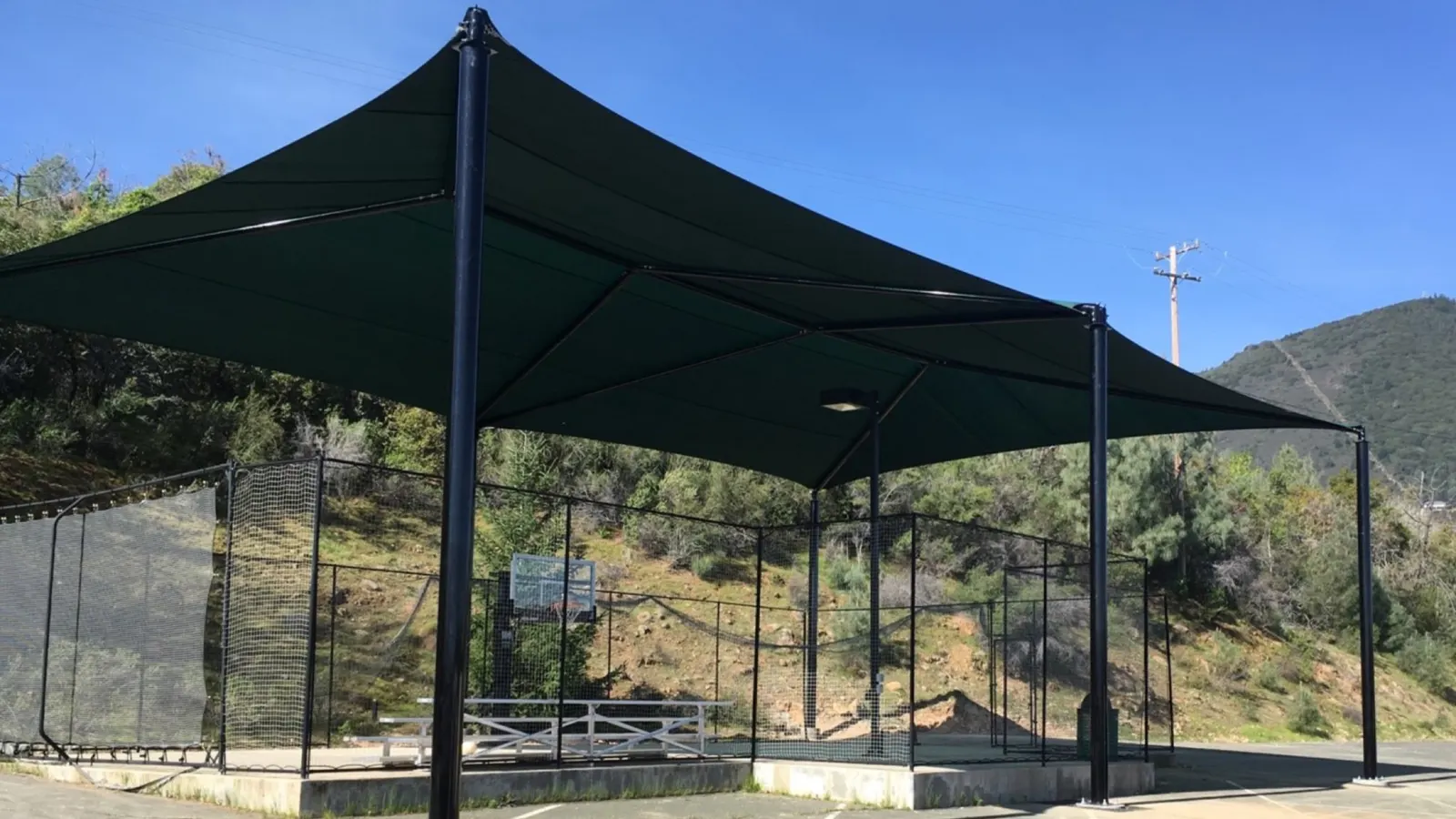
A skate park shade structure is a permanent, engineered canopy installed around the perimeter of a skate park to cover rest areas, spectator seating, entry points, and staging zones, without extending over the actual riding surface. That last distinction matters. Shade sails or canopies placed directly above a bowl, a street course, or a transition can create shadow patterns that trick a rider’s depth perception mid-trick, and support posts anywhere near the riding line become a collision hazard. Good skate park shade structures are engineered around the park, not over it. That rules out a few shortcuts parks departments sometimes try. Pop-up canopies and retail-grade shade sails are not rated for continuous outdoor exposure or for the kind of abuse a public skate park sees, and they do not meet the wind-load engineering that most municipal procurement specs require. A real skate park shade structure is a steel-frame, permanently footed canopy, sized and engineered for the specific site, with fabric or solid roofing matched to the local climate.
Why Shade Matters for Skate Park Operations
Skate parks are almost always built on exposed concrete, which radiates heat back up at riders all afternoon. Without shade, usable hours shrink to early morning and evening in hot climates, and parks departments see attendance drop exactly when community engagement should be highest. Shade over rest zones and spectator areas keeps a skate park usable through the hottest part of the day, which is also when most families are free to visit. There is a liability angle too. Facilities directors are increasingly aware of heat-illness risk for outdoor recreation sites, and OSHA’s guidance on heat exposure is a useful baseline even though skate parks are public recreation space rather than a workplace: shaded rest areas, water access, and a place to cool down reduce heat-related incidents and the associated risk to the municipality. A shaded bench line next to the bowl gives riders, coaches, and parents a reason to stay longer and a place to recover between runs, which is good for the park and good for risk management. Shade also protects the asset itself. Fencing, signage, benches, and nearby playground or fitness equipment degrade faster under constant UV exposure, and a well-placed canopy extends the service life of everything underneath it, not just the people. Parks departments that budget skate park shade structures as part of the original capital project, rather than a later add-on, typically see better long-term returns on both the riding surface and the surrounding site furnishings.
Placement: Shading Rest and Spectator Zones Without Touching the Riding Surface
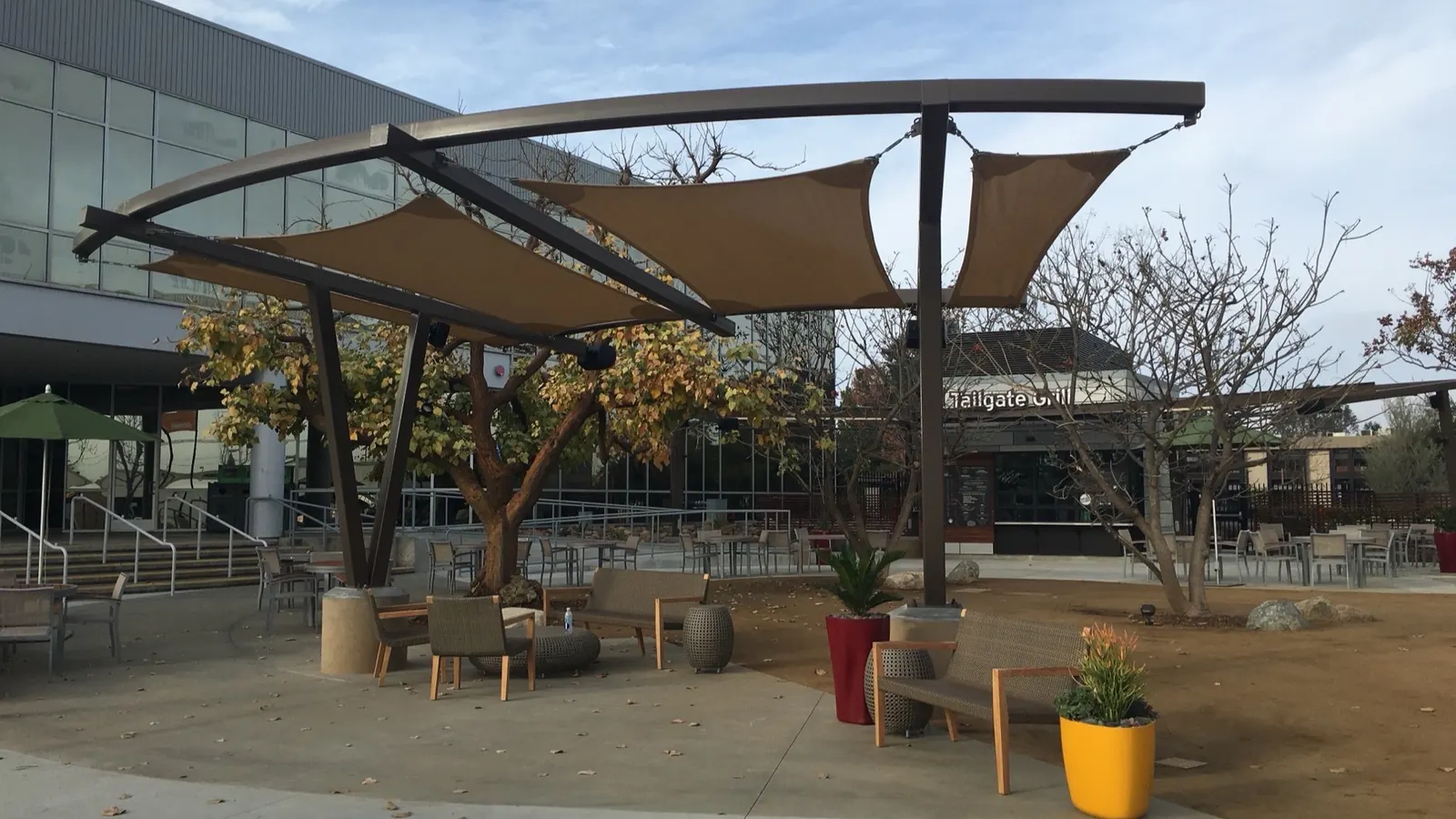
Placement is the single most important design decision for skate park shade structures, and it is where in-house engineering earns its keep. The riding surface itself, including run-out zones and any area a rider could reasonably skate, roll, or fall into, should stay completely clear of columns, footings, and overhead structure. That means shade goes around the park perimeter: entry plazas, bench and bleacher zones, spectator viewing areas along the fence line, and staging areas near equipment lockers or drinking fountains. Cantilever canopy structures are frequently the right call for skate park shade structure projects because the support posts sit outside the shaded footprint entirely, which keeps columns away from walkways and sightlines without pushing the shade back so far it misses the zone riders actually use. A cantilever canopy over a spectator bench row, for example, can project several feet toward the riding area while keeping every post planted safely behind the fence or barrier line. Hip and four-post structures work well for larger plaza or gathering areas where column placement has more room to work with, such as a shaded entry court or a parent waiting area. Orientation matters as much as footprint. A structure oriented to block the low afternoon sun, which is when skate parks see their heaviest after-school and weekend traffic, delivers far more usable shade than one oriented purely for symmetry. Custom Canopies’ design team maps sun path for the specific site before finalizing a layout, which is part of why custom sizing to the nearest inch matters more for a skate park retrofit than almost any other park amenity: these are tight, irregular sites, and an off-the-shelf structure rarely fits without wasting usable shade or creeping toward the riding line.
Vandal-Resistant Hardware and Materials for Skate Parks
Skate parks see more structural abuse than almost any other park amenity: boards and bikes striking lower rails and posts, grinding attempts on any exposed edge, graffiti, and the general wear of a high-traffic youth gathering spot. Shade structures placed near a skate park need the same vandal-resistant thinking that parks departments already apply to benches, fencing, and lighting. Tamper-resistant fasteners, with hardware recessed or capped so it cannot be removed with common hand tools, keep a structure from being disassembled piece by piece. Anti-climb column design, meaning smooth steel posts without horizontal rungs, ladder-like bracing, or footholds, keeps riders and climbers off the structure itself rather than treating it as an extension of the course. Base guards or heavier-gauge steel at the post base protect against board and bike impacts at the height where most contact actually happens. Fabric should be a cut-resistant, UV-stable HDPE or a waterproof PVC membrane depending on climate, finished with a powder-coat steel frame that resists both corrosion and surface scratching from incidental contact. None of this makes a structure vandal-proof, and no manufacturer can honestly claim that. What it does is raise the cost and effort of casual vandalism enough that most of it never happens, and make repairs faster and cheaper on the occasions that something does. For a deeper look at this topic, see our guide to vandal-resistant shade structures, which covers the hardware and materials choices in more detail.
Compliance and Safety: ADA Access, Wind Engineering, and Site Conditions
Skate park shade structures sit on public recreation sites, which means they fall under the same accessibility and structural requirements as any other municipal canopy. Accessible routes to and through spectator and rest areas need to meet ADA path-of-travel and clear-width standards, and shaded viewing areas should include accessible seating or a level, paved surface where a wheelchair user can comfortably watch the park. The ADA.gov accessibility guidelines are the baseline reference for facilities directors scoping this work, and they apply whether the shade structure is new construction or a retrofit onto an existing skate park. Wind engineering is the other non-negotiable. Skate parks are frequently built in open, exposed sites, sometimes with little surrounding structure to break wind, which means canopy fabric and frames need to be engineered for the actual exposure category of the site rather than a generic spec. Stamped engineering drawings, sized to local wind zone and soil conditions, are what a building department or parks department risk manager will ask for before sign-off, and they are standard on every Custom Canopies project regardless of structure size. Fall zones and clearances around the skate park itself, which are typically governed by the park’s original design standards (ASTM F2461 is the common reference standard for skate park design and construction), should also inform where shade structure footings land. A canopy footing placed inside a required clearance zone can force a costly redesign after the fact, which is one more reason to involve the shade structure engineer early in the skate park planning process rather than after the course is finalized.
Materials and Specs: Steel Frames, Fabric Options, and Powder Coating
Commercial skate park shade structures are built on a welded or bolted steel frame, engineered to the site’s wind and soil conditions and set on drilled, concrete footings sized to the structure’s span and exposure. Footing depth and diameter come directly off the stamped engineering drawings, not a generic chart, because skate park sites vary so much in soil type and available clearance. Well-built skate park shade structures also account for the specific abuse profile of a skate park: higher-gauge steel at impact height, fastener patterns that keep hardware away from grinding surfaces, and roof pitches steep enough to shed water without creating a low edge a rider could reach. For roofing, parks departments generally choose between two fabric families. HDPE shade fabric is knitted, breathable, and blocks the large majority of UV transmission while still allowing airflow underneath, which keeps a bench or bleacher zone from feeling stagnant on a still, hot day. Waterproof PVC membrane sheds rain as well as sun, which matters for a spectator zone parents are also using as event seating during competitions or community skate nights. Either option is available in a range of colors, which lets a structure match municipal branding, park signage, or school district colors on a joint-use site. Steel frames are powder coated rather than painted, which holds up far better against the scuffing, graffiti attempts, and general wear a skate park environment produces, and resists corrosion in coastal or high-humidity climates better than a standard paint finish. Column and beam sizing, fastener grade, and footing design all come out of the same in-house engineering process, which means the finished structure is sized specifically for that site’s spans and loads rather than adapted from a catalog part.
Custom Canopies’ In-House Process for Skate Park Projects
Custom Canopies Inc. is a family-owned, made-in-America manufacturer, and every skate park shade structure goes through the same six-step process used on any commercial project, with the site-specific attention a skate park needs built in at each stage. Consultation starts with understanding the skate park’s layout: where riders actually congregate between runs, where spectators gather, where the sun hits hardest during peak-use hours, and where fencing or existing amenities constrain placement. Drafting turns that site information into a structure sized to the nearest inch for the available footprint, engineered around the riding surface rather than through it. Manufacturing happens in-house, which means steel framing, fabric fabrication, and hardware all come from the same shop rather than being sourced piecemeal. Coating applies the powder-coat finish that gives the frame its vandalism and corrosion resistance. Shipping and installation are handled nationally; Custom Canopies ships and installs commercial shade structures anywhere in the US, which matters for parks departments working with a single contractor across multiple sites or regions. Because the whole process runs in-house, from the first site consultation through final installation, a skate park’s unusual geometry, tight clearances, or phased construction schedule can be accommodated without the delays that come from coordinating between a designer, a separate fabricator, and a separate installer.
Common Buying Mistakes with Skate Park Shade Projects
The most frequent mistake with skate park shade structures is treating shade as an afterthought bolted onto the project after the riding surface is already designed and poured. Shade works far better, and costs less, when it is part of the original site plan, because footing placement, orientation, and clearance all have more flexibility before concrete is in the ground. A second common mistake is sizing shade structures for the skate park’s footprint rather than for where people actually stand still. Riders move constantly; spectators, parents, and resting riders do not. Shade belongs over the bench rows, the entry plaza, and the fence-line viewing areas, not spread thin over the whole site in a way that covers little of either the course or the places people actually gather. A third mistake is specifying retail-grade shade sails or off-the-shelf pop-up structures to save money up front. These are not engineered for continuous public use, do not carry the wind-rated stamped drawings a municipal project typically requires, and tend to need replacement or repair well before a properly engineered steel structure would. A fourth mistake is skipping vandal-resistant hardware on the theory that “it’s just a shade structure,” then discovering within a season that exposed fasteners or climbable framing invite exactly the kind of damage the rest of the park was designed to withstand. Finally, some projects skip ADA review on shade-covered spectator areas because the skate park itself has separate accessibility planning; shaded viewing and rest areas need their own accessible route and surface, independent of the riding surface’s compliance.
Cost Drivers for Skate Park Shade Structures
Skate park shade structure costs vary with a handful of factors that are worth understanding before a budget conversation starts, even though site-specific numbers only come from a real quote. Structure size and configuration are the biggest driver: a single cantilever canopy over a bench row costs meaningfully less than a multi-bay hip structure covering a large entry plaza. Wind zone and soil conditions affect footing depth and steel gauge, so a coastal or high-wind site typically carries higher engineering and foundation costs than a sheltered inland park. Fabric choice, HDPE versus waterproof PVC, shifts both material cost and the long-term maintenance picture. Site access and installation complexity matter too; a retrofit around an existing, operating skate park with tight access for equipment generally costs more than shading a greenfield site during initial construction. Vandal-resistant hardware upgrades add a modest premium over standard fasteners and are almost always worth it over the structure’s service life. Because every skate park site is different in layout, exposure, and existing conditions, the only way to get a real number for a skate park shade structure is a site-specific quote rather than a generic per-square-foot estimate.
Frequently Asked Questions
Can a shade structure be installed directly over a skate park bowl or street course?
No. Shade structures should be placed around the perimeter of the riding surface, not over it. Overhead structure and support columns near the riding line create collision hazards and can cast shadows that interfere with a rider’s depth perception mid-trick. Shade belongs over rest zones, spectator seating, and entry areas instead.
What type of shade structure works best for a skate park perimeter?
Cantilever canopies are common for skate park shade because their support posts sit outside the shaded footprint, keeping columns clear of walkways and sightlines. Hip or four-post structures work well for larger gathering spaces like entry plazas where there’s more room for column placement.
How do you make a skate park shade structure vandal-resistant?
Tamper-resistant fasteners, anti-climb smooth steel columns without footholds, reinforced base guards at impact height, cut-resistant fabric, and a durable powder-coat finish all raise the cost and effort of casual vandalism and speed up repairs when something does happen.
Do skate park shade structures need to meet ADA requirements?
Yes. Shaded spectator and rest areas need accessible paths of travel and, where seating is provided, accessible seating locations, independent of whatever accessibility planning applies to the riding surface itself. See ADA.gov for the governing standards.
What fabric holds up best in a high-traffic skate park environment?
Both HDPE shade fabric and waterproof PVC membrane are used on skate park projects. HDPE is breathable and blocks most UV while allowing airflow; PVC membrane adds rain protection, which matters for spectator zones used during events. The right choice depends on local climate and how the shaded area is used.
Can an existing skate park be retrofitted with shade after it’s already built?
Yes, and it’s a common project type. Retrofits require careful footing placement around existing fencing, pathways, and clearance zones, which is why a site-specific engineering review is important before finalizing a layout on an existing park.
How long does a skate park shade structure project typically take?
Timelines vary by structure size, site conditions, and permitting requirements, so there is no single industry-standard number. A site consultation is the best way to get a realistic project timeline for a specific skate park.
Get a Site-Specific Quote for Your Skate Park
Every skate park has its own layout, sun exposure, and clearance constraints, which means skate park shade structures work best when they are engineered for the specific site rather than pulled from a catalog. Custom Canopies Inc. handles the full process in-house, from consultation and drafting through manufacturing, powder coating, shipping, and installation, anywhere in the US. Our team can walk your site, map sun path and clearance zones around the riding surface, and put together a shade plan that keeps riders and spectators cool without touching the course.
Call 480-956-1984 or visit our contact page to start a site-specific quote for your skate park shade structure project. You can also browse our commercial design options and FAQ for more on how we approach municipal and parks projects.